


YEAR FIVE
UPDATE

YEAR FIVE
UPDATE

LET’S GET STARTED

YEAR FIVE OVERVIEW

We successfully delivered over 10,892 tCO2e of carbon reductions in Year 5 of our Net Zero Routemap (2024/25), through a range of activities such as peatland restoration and energy projects.

These also delivered cost savings, improved source water quality in three catchments, increased biodiversity/natural capital across 858 hectares (ha) (equivalent to over 1,000 football pitches), and improved our resilience to a changing climate and energy security risks.

Our reported annual operational greenhouse gas emissions – our total carbon footprint over the year – reduced by 4,546 tCO2e to 220,434 tCO2e. This compares to 224,980 tCO2e last year. This reduction was achieved through reduced energy demand alongside our carbon reduction energy efficiency measures and increased on-site renewable energy production. Changes to the emission factors for grid electricity increased over the past year, increasing our footprint by 202 tCO2e.

Our carbon reduction activities are vital as a changing climate is threatening our ability to deliver essential water and waste water services. We must therefore adapt our approaches and do everything possible to minimise the carbon emissions associated with our activities and maximise the positive contribution we can make.

DELIVERY

We continued to make progress across all areas of our routemap and delivered actions which eliminated, reduced or captured emissions.

Highlights include:

  • Completed another record year of over 50 energy efficiency projects enabling an additional 6.28 GWh reduction in electricity use this year with > 1,400 tCO2e therefore saved.
  • Delivered 16 renewable schemes with 6.42 GWh renewable electricity generation capacity including an 0.82 GWh siphon hydro energy scheme at Whiteadder Reservoir in East Lothian and our first battery storage scheme linked to solar renewable energy at Howden Water Treatment Works.
  • Increased our electric vehicle numbers by 79 this year to 540 overall and increased our charging points from 291 to 374.
  • Delivered our largest peatland restoration programme to date with 555 ha restored supporting carbon capture alongside water quality, biodiversity and climate change resilience improvements.
  • Planted a record 208 ha of native broadleaf woodland with oak, alder, hawthorn, rowan and birch trees and confirmed the establishment of 95 ha of natural woodland regeneration predominantly at Loch Katrine.
  • Obtained the PAS 2080 (Publicly Available Specification) certification for carbon management in buildings and infrastructure. We are the first public organisation in Scotland to achieve this demonstrating leadership in carbon management and reduction in our investment programme.
  • Implemented a low carbon site equipment kiosk framework and installed lower carbon site kiosks with our capital partners using recycled plastics, light gauged steel and timber.
  • Undertook a circular economy low concrete pilot with Breedons, Marshalls and Recyl8 producing manhole covers, a structural foundation and a cable trough reusing Incinerator Bottom Ash Aggregate material which would otherwise go to landfill.
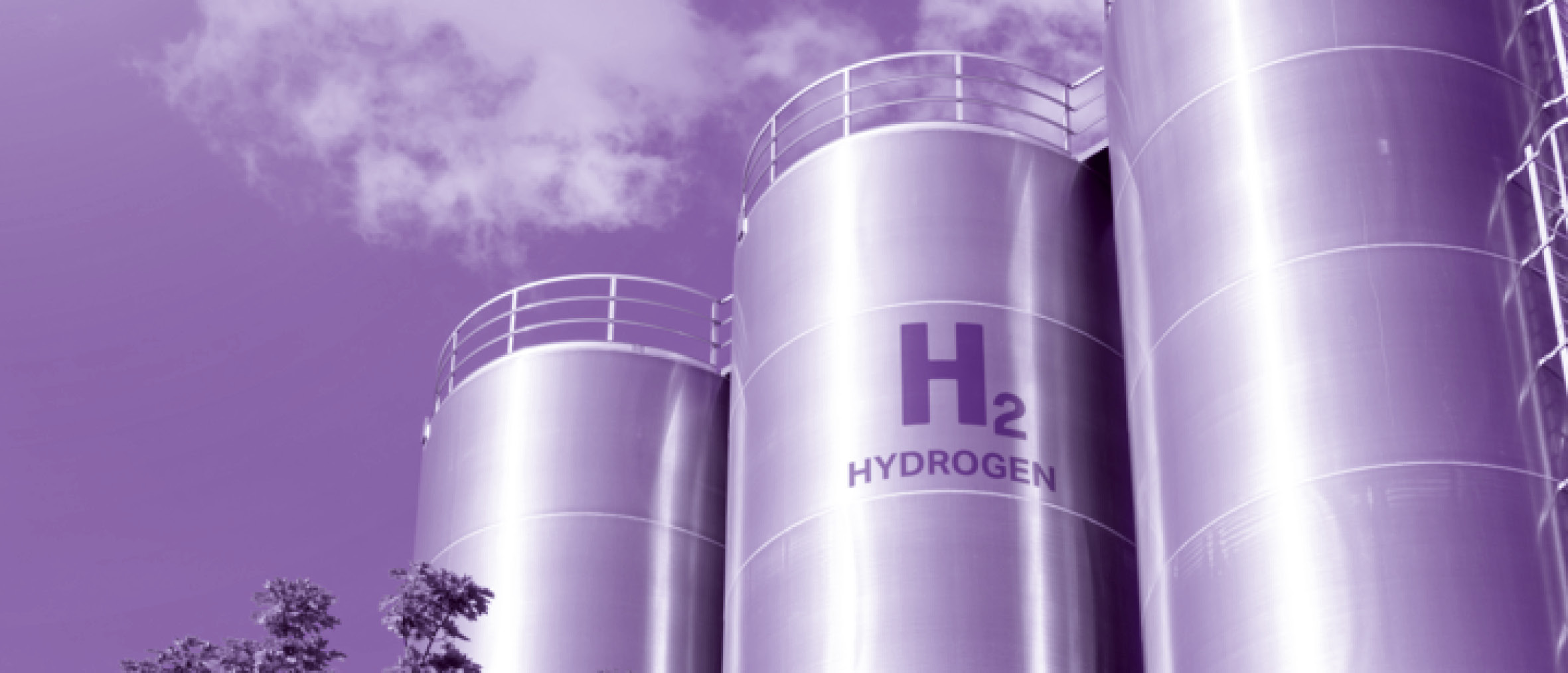
  • Supported the development of over 80 hydrogen projects with the potential to generate 7 GWh of hydrogen capacity with a focus on using final effluent from our waste water treatment works.

LEARNING

We continue to review our progress and learn from our experiences.

  • We need to improve our knowledge and technical capabilities.

We have recognised that we need to expand our knowledge and capabilities around the installation of process emission monitors in our activated sludge waste water sites and their data connectivity with our existing digital systems. We have increased our resourcing in this area and have on-boarded a further company to help support monitor installation.

To reinforce the management, continuous improvement and learning required to embed net zero across all we do, we have worked towards successful accreditation this year with the PAS2080 (Publicly Available Specification) for carbon management.

  • We need to always assess if the low carbon products we introduce are the right ones to use.

We completed a review of our supply chain for hydrotreated vegetable oil (HVO). HVO is now being used to support carbon emission reductions in the parts of our fleet that are currently unsuitable for EVs due to load or distance factors. The HVO we use is certified as not containing virgin palm oil. Following our review and on-going scrutiny of our supply chain we have no evidence to suggest that virgin palm oil has been used.

To address modern slavery concerns in solar panel materials we have now established an ethical supply chain for solar panels. However, it is taking time to implement and this may mean reductions in our planned renewable programme for the rest of this regulatory period.

  • We need to continue to work with landowners/tenants to address concerns and promote benefits of peatland restoration.

Whilst it was a record year for peatland restoration, several projects could not be completed due to challenges around gaining support from landowners/tenants in our water catchments.

PARTNERSHIP

We can only achieve our Beyond Net Zero ambition by working in partnership and we are continuing to strengthen and expand our activities in this area.

Our 10 year land management plan for Loch Katrine with Forestry and Land Scotland (FLS) was approved by Scottish Forestry (SF) in 2024. This supports the capture of up to 1 million tCO2e over the next 60 years by creating and regenerating 4,380 ha of woodland and restoring up to 400 ha of peatland. FLS are now underway with 24 ha woodland planted and over 90 ha of land reached sufficient maturity and density through natural regeneration to be re-classified as native woodland this year. We also restored 55 ha of peatland and working with the Hydro Nation Chair installed innovative peatland restoration monitoring. Loch Katrine Research – Scottish Water

Our partnership with the Royal Botanic Garden Edinburgh on their ‘plants with purpose’ programme is progressing well and our PhD student has now been appointed. They are examining and optimising planting schemes to support carbon reduction in blue-green infrastructure projects such as rain gardens and storm water planters.

In 2024/25, we completed three woodland creation projects in East Renfrewshire and South Lanarkshire (Dunside Water Treatment Works, Glengavel Reservoir and Newton Mearns Waste Water Treatment Works), planting a total of 41 ha within the Clyde Climate Forest. This builds on the 19 ha of woodland already created adjacent to the Clyde Climate Forest boundary. In 2025/26 we have three woodland creation projects planned in the Forth Climate Forest area.

Hydrogen will be an important fuel in the wider Net Zero transition, and water is a key component in the production of hydrogen. To support the growing hydrogen economy, Scottish Water Horizons is working with stakeholders and production companies on over 80 projects across the country with a potential hydrogen capacity of over 7 GW. To provide the most sustainable and economic input source, and to conserve water supplies within the catchment, our preferred water source for hydrogen production is final effluent from our waste water treatment works.

In our commitment to partnership Scottish Water continues to work with the Edinburgh and Glasgow Climate Compact to help to boost climate action.

And our Low Carbon Concrete Collective (LCC) with Network Rail, SSE, Scottish Power and Transport Scotland is continuing to make progress. The Collective was established in 2022 to accelerate the development, availability and adoption of the next-generation of low carbon concrete in Scotland and are progressing the design and pilot of:

  • Pre-cast low carbon concrete manhole ring using a GGBS-blend with Recycl8’s innovative bottom ash aggregate which uses landfill waste embracing the circular economy.
  • A structural foundation using the Recycl8 mix.
  • A pre-cast cable trough using the Recycl8 mix.

We are also progressing with the Advanced Market Commitment for low carbon concrete with Innovate UK.


Transport Scotland
Story
SSE
Scottish Power
Scottish Water
Recycle8
NetworkRail
Marshalls
RJ McLeod
Ibstock
George Leslie
Breedon

If you would be interested in partnering with us for example to:

  • extend peatland regeneration, woodland planting and biodiversity schemes.
  • demonstrate renewable energy technologies and low carbon products.
  • establish blue-green and nature based rural and urban catchment solutions.

Please contact our Net Zero lead Elise Cartmell.

COMMUNICATION AND ENGAGEMENT

To encourage knowledge sharing, our Net Zero Heroes network continue to go from strength to strength. We now have approaching 100 people meeting together regularly from Scottish Water and our supply chain partners to share best practice. It includes people who have enabled and implemented carbon savings and carbon capture opportunities and others who have improved Net Zero reporting or delivered an exemplary project to help us with our sustainability ambitions. We have also initiated work with some of our key equipment suppliers to better understand how their products will decarbonise over time. This has allowed us to update our pathway to Net Zero investment emissions.

We are starting to link in with community groups with woodland planting. We have completed planting days with Friends of the Pentlands at Glencorse successfully planting around 400 native broadleaf samplings and at Roscobie Reservoir with local communities and the Fife Coast and Countryside Trust (FCCT) to plant around 1,600 silver birch, downy birch, oak, elder, hawthorn and crab apple tree saplings across a 1.4 ha area surrounding the reservoir.

Team Effort for Trees at Glencorse – Scottish Water
Volunteers Dig In to Create Native Woodland at Roscobie Reservoir – Scottish Water

We and our partners have been externally recognised for our work receiving three awards in 2024/25.

ICE Scotland Sustainability Champion Award - Ian Watt

ICE Scotland Sustainability Champion Award – Ian Watt
Built Environment Smarter Transformation Ross Shire Enginering - Gamechanger Award, Timber Modular Build

Built Environment Smarter Transformation Ross Shire Enginering – Gamechanger Award, Timber Modular Build
WGMB and Scottish Water - Circular Economy MEICA Strategy for Utility Assets - Utility Week Awards 2024

WGMB and Scottish Water – Circular Economy MEICA Strategy for Utility Assets – Utility Week Awards 2024


PROGRESS IN YEAR

During 2024/25 we made good progress across all four key strategic activity areas of our routemap:

icon - strategic 1

BECOMING MORE
ENERGY EFFICIENT

Saved 6.28 GWh of electricity in our water and waste water services through over 50 energy efficiency projects through pump refurbishment, variable speed drive (VSD) installations, air source heat pumps and LED lighting projects. The installation of air source heat pumps has also reduced the requirement for heating oil.

Saved 4.08 GWh at our waste water treatment works, 0.84 GWh at our waste water sludge pumping stations and 1.36 GWh at our water treatment works.

Completed 16 renewable energy projects with a generating capacity of 6.42 GWh.

Installed a European first 0.82 GWh siphon hydro energy scheme at Whiteadder Reservoir in East Lothian.

Case study – Whiteadder Hydro Scheme

Case study – Howden Solar and Battery

icon - strategic 2

USING LOWER-CARBON
ENERGY PRODUCTS

Added a further 79 electric vehicles to our fleet giving us 540 in total and expanded our number of charging points to 374.

Deployed sustainable hydro-treated vegetable oil (HVO), which has c. 90% lower carbon emissions compared to diesel, with our investment programme partners and within our Scottish Water fleet and standby generators.

Used recycled aggregate material in excavations and service reservoir overburden.

Implemented our low carbon kiosk framework with Ross Shire Engineering, Quinnshield and Capvond with 15 orders of wood kiosks already placed.

icon - strategic 3

embracing low
carbon construction

Adopted low carbon steel reinforcement (Rebar) products with c. 50% lower CO2e content. Approximately 12% of our construction emissions are associated with Rebar products and therefore a reduction of 5-6% of our total construction emissions is now possible.

Continued with our low carbon concrete pilots producing a pre-cast low carbon concrete manhole ring, a structural foundation and a pre-cast cable trough using a ground granulated blast-furnace slag (GGBS) blend with Recycl8’s bottom ash aggregate using landfill waste. This embraces the circular economy alongside carbon reduction.

Completed a Research and Innovation project on a pump refurbishment trial with WGM, installing 29 refurbished pumps and saving c. 68tCO2e and c. £129,000.

icon - strategic 4

storing away emissions that
cannot be avoided

Restored a record 555 ha of peatland in our water catchments.

Planted 208 ha of native broadleaf woodland with oak, alder, hawthorn, rowan and birch trees.

Confirmed the establishment of 95 ha of natural woodland regeneration at Loch Katrine and other sites.

These activities also improve source water quality and biodiversity and support our catchments becoming more resilient to climate change impacts.

KEY FUTURE OBJECTIVES

FOR YEAR 6 AND YEAR 7 APRIL 2025 – MARCH 2027

Years 6 and 7 in our routemap bring us to the end of our current regulatory period Strategic Review of Charges 2021 – 2027 (SRC21). Our plan is to continue our delivery focus on carbon reductions and to prepare activities for our next regulatory period Strategic Review of Charges 2027 – 2033 (SRC27).

In particular we will:

  • Develop and deliver opportunities to reduce emissions, particularly in energy efficiency, renewable energy and our vehicle fleet including trialling our first fully electric HGV and installing hydro-treated vegetable oil (HVO) tanks for existing diesel vehicles not yet able to transition to electric.
  • Work with our partners on the development of hosted wind farms on our land.
  • Progress work to improve measurement and control of nitrous oxide emissions at large waste water treatment works including examining mitigation measures at more sites.
  • Work with our supply chain partners to introduce low carbon designs and materials and to expand the “art of the possible” to reduce investment emissions.
  • Progress changes to how we capture data to allow us to better measure Carbon.
  • Progress woodland creation and peatland restoration on our landholding to improve carbon capture to balance our forecast residual emissions. This includes developing two of our catchment scale Water Woods at Talla and Glenhead of Woodlands.
  • Continue work on our Circular Economy Resource Recovery Factory at Alloa implementing our resource recovery treatment unit for grit and planning our cellulose and nutrient units.
  • Continue to develop blue-green infrastructure to support climate change resilience and carbon reductions alongside biodiversity improvements.
  • Engage with other UK and international water companies and other sectors to share and grow our knowledge on how to reduce emissions including leading on the Adaptation and Nature forum at the International Water Association World Water Congress in August 2026 at Glasgow.

FOR OUR NEXT REGULATORY PERIOD 2027-2033

We will act across all key strategic goals in our routemap to:

Minimise Operational Emissions

  • Fleet: continue adoption of low emission vehicles and infrastructure as we renew our fleet in SRC27.
  • Bioresources: invest in advanced anaerobic digestion and energy recovery at returning PFI Sludge Treatment Centres.
  • Property and Estates: adopt zero emission systems as heating, ventilation, and air conditioning (HVAC) and other building systems requiring renewal. Look at options around replacing our Juniper House laboratory, reducing our gas and electricity demands.
  • Energy: displace up to a further 35 GWh of grid electricity through energy efficiency and on site renewable solar and hydro generation during SRC27.
  • Water demand: implement leakage reduction, mains renewal and non-domestic metering to support reduced water production and energy use.
  • Process emissions: implement monitoring, real time control and optimise existing waste water systems to reduce emissions; invest in research and piloting of new technologies to capture methane and ammonia and to limit process emission production and release.

Minimise Investment Emissions

  • Design: continue to work with our supply chain partners to avoid the need for new construction, to introduce low carbon designs/circular economy principles and select for low emission options including nature based solutions.
  • Materials: procure low or zero emission materials and switch to reusing and repurposing materials/assets.
  • Construction: build using low or zero carbon construction techniques.
  • Data: progress changes to how we capture investment carbon data to allow us to better measure carbon.

Increase Carbon Capture on our land

  • Peatland: restoration of 500 – 1,000 ha of actively eroding peatland; continued management and maintenance of existing peatland.
  • Woodland: creation of up to 4,000 ha of new woodland with 6 million trees through active planting and natural regeneration.

2024/25 OPERATIONAL EMISSIONS FOOTPRINT

GREENHOUSE GAS EMISSIONS BY SOURCE

sw-footprint-2025

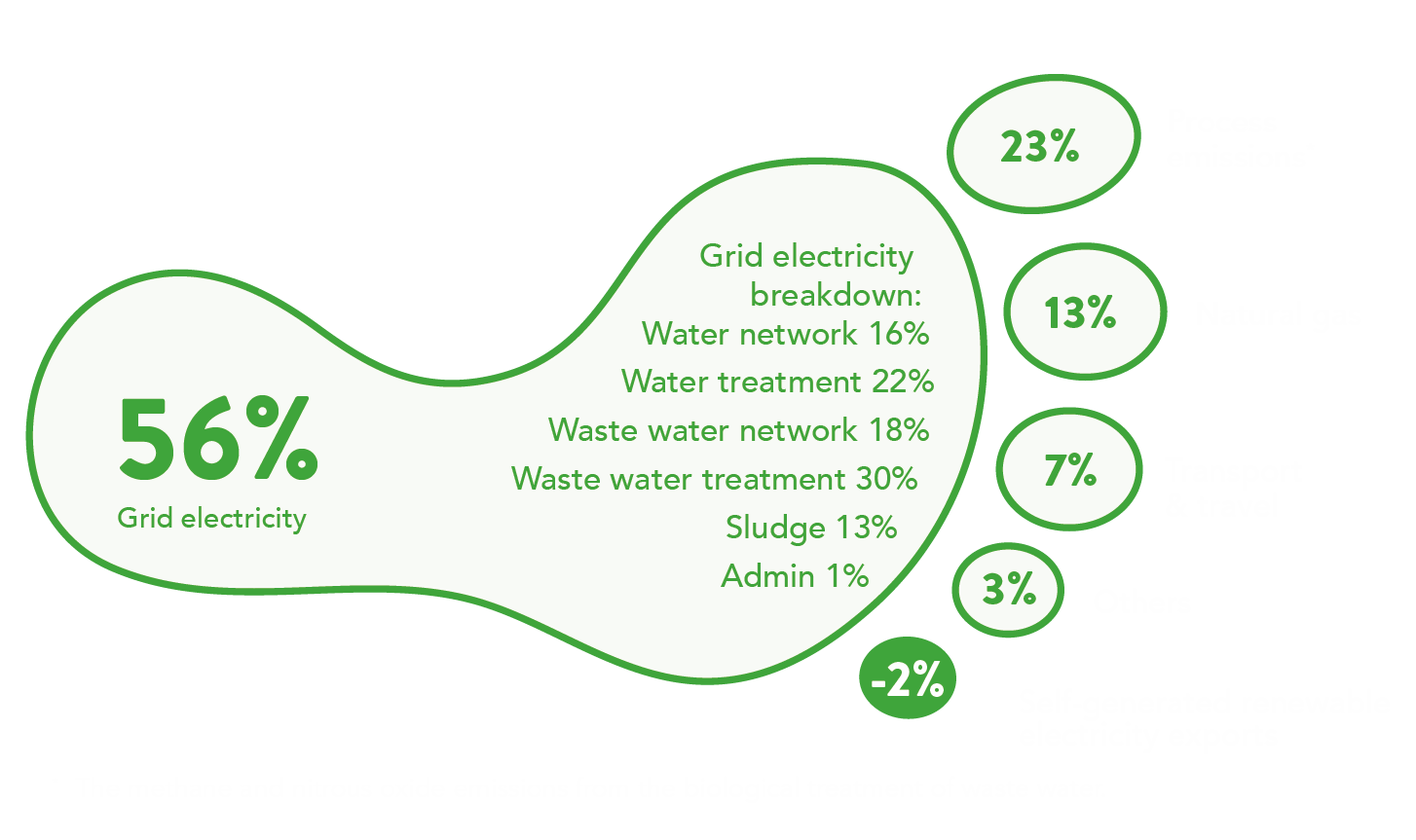
Our operational greenhouse gas emissions – our carbon footprint – were 220,434 tCO2e. This compares with 224,980 tCO2e last year.

This significant reduction was achieved due to reduced energy demand alongside energy efficiency measures and increased on-site renewable energy production. Changes to the emission factors for grid electricity increased the impact of our activities by 202 tCO2e.

Our actions are resulting in a continued downward trend for our operational emissions, and we remain on track to deliver net zero before 2040.

To do this we need to progress hosted wind farms on our land, invest in new technology to replace ageing sludge drying facilities and for the electricity grid to decarbonise. These, along with current intelligence on progress of process emissions reductions and forecast increase in carbon capture on our land show that we should achieve operational Net Zero in the mid-2030s.

As in previous years the footprint was successfully verified externally to ISO 14064-1.

The continued greening of the grid coupled with increased energy efficiency and renewables delivery has made a significant contribution to our progress, but at 56% of emissions, electricity remains our biggest source.

At 23%, process emissions from waste water treatment are the next biggest source, which is driving much of the focus on innovation and research to minimise these emissions in the future.

PROGRESS UPDATE

We have highlighted key milestones on the way to net zero in our routemap which covers all aspects of our emissions. Our milestones are supported by a range of actions and activities to build capacity and capability which we undertake to deliver specific goals over defined timescales to reach net zero.

Progress across our goals can be viewed in the sections below.

ELECTRICITY

Electricity consumption is still our largest single source of emissions at 56%. We must reduce our consumption to reduce emissions and increase financial benefits, while enabling us to support other goals such as generating all the electricity we consume.

1. Reducing our consumption of electricity

GOAL: 20% reduction by 2040

  • 6.28 GWh of energy efficiency projects were delivered against an in-year target of 5.43 GWh for 2024/25.
  • Over the last 5 years we have delivered 26 GWh savings in efficiency projects – a 5% reduction of our grid electricity demand from the start of our routemap in 2019/20.
  • Total grid electricity consumption overall is down by 3% since we started our routemap which also accounts for new demands.
2. Maximising the energy we recover from bioresources
  • 38.7 GWh of energy was generated from bioresources in 2024/25 by Scottish Water and PFI partners.
  • Co-digestion of whisky and brewery co-products at Nigg continued to generate more energy. Co-digestion at our Seafield site in Edinburgh was delayed but trials have started for a possible full-scale start 2026.
3. Generating or hosting all the energy we use

GOAL: 100% of energy used is our own or hosted renewables by 2040

  • Delivered 6.42 GWh of additional renewable capacity through solar and hydro generation. An additional 6.5 GWh of additional renewable capacity is planned for delivery in 2025/26.
  • Overall 59.1 GWh of renewable electricity was generated in 2024/25.
  • Renewable energy hosted on our land was 952 GWh.
  • Continued to progress 282 GWh of new windfarms with RWE and Wind Estates which will be located on our land. The projects are estimated to be commissioned in 2028.
  • Continued to work with developers to identify additional windfarm opportunities.

PROCESS EMISSIONS

Process emissions, particularly nitrous oxide (N2O) remain the most challenging area for the water sector to address, requiring a focus on the science, measurement and management of emissions, as well as on technologies to reduce or eliminate the production of emissions.

1. Reducing our production of process emissions

GOAL: 20% reduction by 2040

  • Our full-scale methane recovery unit at Nigg Waste Water Treatment Works is proceeding through detailed design.
  • Our nitrous oxide monitoring has now been rolled out to a total of six sites with a further two sites ready for install in summer 2025.
  • We are an early adopter of gas hood technology to validate our liquid nitrous oxide probe (Unisense) data, as well as having developed our own gas hood which is being validated to enable spot checking of process emissions.
  • Innovative LiDAR (laser process emissions detection) has been successfully trialled for site-wide methane detection and quantification. Discussions have started around its use under business as usual.
  • We have used machine learning, modelling and other artificial intelligence software to support our data gathering and analysis and are using this to help inform actions. We continue to pursue the use of artificial intelligence and modelling to complement our use of hard sensors.
  • We are working with operational colleagues to put in place process emission mitigations on site.

Philipshill Waste Water Treatment Works (WwTW) – you can’t control what you can’t measure.

GAS AND FUEL OIL

Reducing our reliance on fossil fuels across all of our sites is a key part of getting to net zero. This has proven a complex matter as we rely heavily on fuels for emergency and stand-by generators and extreme weather events are becoming more frequent and intense.

1. Maximising the energy we recover from bioresource

38.7 GWh of energy was generated from bioresources in 2024/25 by Scottish Water and PFI partners

2. Eliminating consumption of gas and fuel oil

GOAL: 100% reduction

Key Achievements:

  • Implemented our sustainable hydro-treated vegetable oil (HVO) procurement framework with our delivery partners.
  • Continued to expand HVO use to our standby generators and Scottish Water’s commercial fleet vehicles by using public refuelling stations at Forfar, Ecclefechan and Dumfries and one of our partner’s (Clancy) HVO tanks at its site in Livingston. These trials have been successful to date and will continue this year for fleet vehicles not able to transition yet to EV due to load and range restrictions.
  • Installed 50 new air source heat pumps this year, giving us a total of 98 so far.
  • We have reduced our natural gas consumption by 17% since 2019/20.
  • Our overall use of liquid fossil fuels has increased by 5% as to help combat climate change impacts an increased number of standby generators are now in use. We aim to reduce their impact by expanding our standby generator HVO usage.

TRANSPORT AND TRAVEL

Our fleet recorded travel of 22 million miles last year delivering service for customers. This is a four million increase on the previous year. The reason for this increase is that we moved to a new telematics supplier and telematics were fitted to all long-term hire vehicles, meaning these numbers were added for the first time.

Our strategy aims to minimise the miles we travel and find zero emissions ways to travel.

1. Reducing fleet mileage and business travel

GOAL: 50% reduction in the distance we travel

  • Several transformation projects led to reduced fleet mileage – from a trial using customers mobile phone cameras to triage customer calls, avoiding up to a third of home visits, reducing the number of sludge tanker journeys and avoiding journeys following proactive clearing of sewer blockages.
2. Transitioning our fleet to zero emissions vehicles

GOAL: 100% Zero Emissions Fleet

  • Taken delivery of a further 79 fleet electric vehicles this year. We now have 540 electric vehicles ranging from fleet vans to lease cars. 100% of our lease cars and car fleet are now electric and 10% of our van fleet is electric.
  • Increased the number of electric vehicles charging points to 374 from 291 last year and these are increasingly utilising renewable energy generated on our sites.
  • We now have 245 electric vehicles in use through our employee salary sacrifice scheme to support their EV purchase. This is an increase of 92 in year with a further 40 vehicles ordered and awaiting delivery.
  • Increased our use of HVO for fleet vehicles not yet able to transition to electric and developed a network of access points across Scotland.

Hydrotreated Vegetable Oil (HVO Trial).

INVESTMENT

We were the first UK water company to include investment emissions as part of our net zero goal. Now that our operational emissions are reducing investment emissions are now our biggest source of emissions each year.

1. We enable zero emission construction

GOAL: 75% reduction in carbon intensity of investment

  • Obtained PAS2080 accreditation (Carbon Management in Buildings and Infrastructure). This ensures that we have a framework to deliver further emission reductions and continuously improve our process and systems for monitoring and measuring carbon in projects.
  • Supported the development and committed to the Infrastructure Client Group / Construction Leadership Council’s 5 Client Carbon Commitments. This includes our support and collaboration on the Concrete Decarbonisation Accelerator, which identified straightforward actions to work collectively with the wider UK industry. This approach aims to accelerate the industry’s transition to using decarbonised concrete, rather than having each member conduct individual research projects and pilots.
  • Led carbon reduction workshops covering nine key construction programme areas, identifying immediate, short-term, and long-term opportunities for reducing carbon emissions.
  • Established the on-line Net Zero Network for knowledge sharing with the wider supply chain to enable greater collaboration with the wider supply chain.
  • Explored 3D printing applications for concrete and plastics. 3D printed manhole rings and a combined sewer overflow (CSO) chamber were successfully delivered to Scotland for use in the Improving Urban Waters programme.
  • Continued to improve how we calculate carbon on projects so we can better assess the carbon intensity of our investment programme and completed a project with Circular Ecology to update our carbon investment data.
  • Continued to develop our Low Carbon Concrete Collective group with other infrastructure organisations across Scotland to accelerate the development, availability and implementation of the next-generation of low carbon concretes in Scotland including Recyl8 products.
  • Implemented a low carbon kiosk procurement framework making it easier to use these kiosks and avoid using glass reinforced plastic kiosks. The framework low carbon kiosks are 50-75% lower in carbon than our traditional designs.
2. Delivering zero emission investment with supply chain

GOAL: 75% reduction in carbon intensity

  • Our Net Zero Heroes group has continued to share best practice from projects and new products on reducing carbon, leading to wider adoption across our programme.
  • Increased the use of low carbon concrete blended mixes across the country and updated our procurement framework to include these mixes. Projects like our Braidholm Flood Alleviation project used an Eco Pack concrete mix that saved 15 tCO2e in a single pour.
  • Started to adopt green steel on projects, with the use of recycled steel manufactured in Electric Arc Furnaces.
  • Started to adopt low carbon kiosks in projects. These typically reduce carbon between 50 and 75% of traditional kiosks. Working with our delivery partners we installed our first ever circular economy timber kiosk at Howdenwells which was manufactured from timber felled on Scottish Water land.
  • Completed a Research and Innovation project on a pump refurbishment trial with WGM Boulting, installing 29 refurbished pumps and saving c. 68tCO2e and c. £129k.
  • Increased the use of more recycled aggregates on site and backloading of waggons to reduce transport movements during construction.
  • Reused water for pressure testing, reducing tanker movements when commissioning strategic water infrastructure projects.
  • Applied pneumatic compactors on site to reduce skip movements on the treated water storage programme of work.
  • Continued with our business as usual application of our standardised low carbon construction site set ups, with the use of eco cabins, low carbon on site power generation with hydrotreated vegetable oil and battery, LPG technologies and wider adoption of the use of electric plant and hand tools.

Howdenwells Timber Kiosk

SUPPORTING A FLOURISHING SCOTLAND

Across the 23,500 hectares of our land, we can contribute to the natural, social and economic sustainability of Scotland’s landscape by working to increase carbon storage and biodiversity

1. We will capture and store more carbon dioxide than we produce

GOAL: Improve carbon dioxide storage on our land to support net zero emissions

  • Restored a record 555 ha of peatland improving carbon capture, water quality and biodiversity.
  • Planted a further record of 208 ha of new native woodland.
  • Achieved natural regeneration of 94 ha of land predominantly at Loch Katrine.
  • Continued to screen our landholdings for further peatland restoration and tree planting potential, to deliver carbon capture and biodiversity benefits whilst not impacting our tenant farmer incomes.
  • Completed interventions at 12 of our sites, including water and waste water treatment works, equating to 5.07 ha of biodiversity improvement.
  • Improved local habitats through the installation of bird and bat boxes, hedgerow planting, tree planting, meadow creation, wader scraps and invasive species removal.

Rhizocore Trial.

ENABLERS

We cannot achieve our ambitious goals alone and we assume that required future investment funding is available. On our journey to net zero there are some key enabling activities which we have progressed in the last year.

PEOPLE

  • Grew our use of Carbon Academy to share best practice and be a focal point for learning activities both within Scottish Water and across our supply chain.
  • Established the on-line Net Zero Network for knowledge sharing with the wider supply chain to enable greater collaboration with the wider supply chain.
  • Engaged our delivery partner leaders to focus on driving behaviour change to deliver net zero.

CUSTOMERS AND COMMUNITIES

  • Douglas Park Community Consultation in Dundee – Read more.
  • Woodland creation consultation – Read more.
  • Generation H2O – inspiring responsible water citizens – Read more.
  • Top Up Taps help reduce single use plastics – Read more.
  • Inchgarth biodiversity improvements – Read more.
  • Draining the rain in Prestwick and Craigleith – Read more.

GOVERNANCE

  • Our carbon footprint was audited to ISO14064-1.
  • Obtained PAS2080 certification, the standard for managing carbon to understand how we can improve our processes for carbon management.

POLICY AND REGULATION

  • Continue to have the vice-chair role of the Sustainable Scotland Network contributing to climate policy and strategy.
  • Worked with the Scottish Government and the Economy and Environment Leaders Group through the Public Sector reform initiative to develop collective approaches to “pioneer catchments” – establishing pilot work to support alignment of policy and action between public bodies to deliver carbon, climate and nature benefits at landscape scale.
  • Worked with the Scottish Government to inform the review of publicly owned lands and their natural capital status.
  • Worked with NatureScot to pilot measures for the reporting of land positively managed for nature, which will be used to inform our approach to reporting on nature in the next regulatory period.

PROCUREMENT

  • Continued to work with our 440 suppliers to understand their emissions and to develop emissions reduction plans.
  • Continued to ensure carbon management is interwoven into the procurement process with Scottish Water, requiring all tenderers to agree to measure their carbon emissions and have a carbon plan in place.
  • Implemented our low carbon kiosk framework. This will allow Scottish Water to purchase kiosks made from alternative materials with a lower embodied carbon to the traditional Glass Reinforced Plastic or steel kiosks currently utilised and in doing so, enable greater steps towards our net zero targets.
  • Completed a review of our HVO supply chain to ensure no virgin palm oil material was being used.
  • Continued to lead Scotland’s Low Carbon Concrete Collective, an industry partnership with key infrastructure organisations including SSE, Scottish Power, Network Rail and Transport Scotland.
  • Completed analysis of our concrete use to monitor progress against increasing our use of low carbon (non CEM1) materials.
  • Continued to explore circular economy opportunities such as increasing the level of refurbishment of our key assets such as bridge scrapers and pumps.
  • Launched a procurement activity for low emission steel that is produced from an electric arc furnace, providing a significant decrease in carbon emissions compared to traditional manufacturing methods.

INNOVATION

  • Continued to deploy our process emissions monitors including developing our own nitrous oxide hoods.
  • Completed a LiDAR study with the Hydro Nation Chair to monitor natural regeneration of woodland at Loch Katrine.
  • Collaborated with water companies in Singapore and New Zealand on process emission monitoring and reduction technologies.
  • Progressed development of ammonia recovery technology.
  • Trialled innovative low carbon materials.
  • Progressed research though our Hydro Nation Chair and research fellows.

NET ZERO RESEARCH AND INNOVATION

We have progressed a number of activities across these areas, click each icon to read more.

AMMONIA RECOVERY TRIAL

Progression of a 5m3/day ammonia recovery technology has continued with programme and contracts being finalised. Started on site in Autumn 2025.

We will test the Ammonium sulphate liquid produced for all European fertiliser regulation requirements to ensure the quality of the output material meets specifications required and can potentially be reused.

NITROUS OXIDE CAPTURE AND DESTRUCTION TECHNOLOGY

We are planning a trial of an activated sludge plant cover and destruction technology with Powerplastic and Suez. This will utilise an odour control style cover which collects the off gases and then actively blows the gases into a photocatalytic destruction box with tuneable UV and catalyst concentration.

Preliminary designs complete and final designs underway with the potential to capture ? tonnes CO2e.

Read more.

DIGITAL AND ANALYTICAL TOOLS – METHANE MEASUREMENT AND LiDAR

A short scale trial for methane leak identification and whole site quantification has been undertaken utilising QLMs technology on a trailer.

This trial allowed Scottish Water to identify areas for potentially high-level emissions which were in line with assumptions made prior to the trial.

Read more.

DIGITAL AND ANALYTICAL TOOLS – LiDAR TO EXAMINE NATURAL REGENERATION OF WOODLAND

Completed a LiDAR (Light Detection and Ranging) study with the Hydro Nation Chair to monitor natural regeneration of woodland at Loch Katrine.

This study examined tree cover greater than 1.5m above ground, across > 500 ha of targeted sites in the region of Glen Gyle at the head of Loch Katrine.

Read more.

MATERIALS RESEARCH

Concrete Collective (LCC) with Network Rail, SSE, Scottish Power and Transport Scotland is continuing to make progress. The Collective is progressing the design and pilot of new concrete materials including:

  • Pre-cast low carbon concrete manhole ring using a GGBS-blend with Recycl8’s innovative bottom ash aggregate which uses landfill waste embracing the circular economy.
  • A structural foundation using the Recycl8 mix.
  • A pre-cast cable trough using the Recycl8 mix.

HYDROGEN PRODUCTION

Supported by the Scottish Government, Scottish Water Horizons have been collaborating with the NHS to establish whether waste water heat recovery from Scottish Water’s sewerage network can be utilised to help heat NHS facilities to reduce their carbon footprint. This is showing positive results and work is ongoing to carry out flow and temperature measurements to establish the available energy. One site has progressed to the stage of carrying out a detailed engineering study.

AMMONIA RECOVERY TRIAL

Progression of a 5m3/day ammonia recovery technology has continued with programme and contracts being finalised. Started on site in Autumn 2025.

We will test the Ammonium sulphate liquid produced for all European fertiliser regulation requirements to ensure the quality of the output material meets specifications required and can potentially be reused.

NITROUS OXIDE CAPTURE AND DESTRUCTION TECHNOLOGY

We are planning a trial of an activated sludge plant cover and destruction technology with Powerplastic and Suez. This will utilise an odour control style cover which collects the off gases and then actively blows the gases into a photocatalytic destruction box with tuneable UV and catalyst concentration.

Preliminary designs complete and final designs underway with the potential to capture ? tonnes CO2e.

DIGITAL AND ANALYTICAL TOOLS – METHANE MEASUREMENT AND LiDAR

A short scale trial for methane leak identification and whole site quantification has been undertaken utilising QLMs technology on a trailer.

This trial allowed Scottish Water to identify areas for potentially high-level emissions which were in line with assumptions made prior to the trial.

Read more.

DIGITAL AND ANALYTICAL TOOLS – LiDAR TO EXAMINE NATURAL REGENERATION OF WOODLAND

Completed a LiDAR (Light Detection and Ranging) study with the Hydro Nation Chair to monitor natural regeneration of woodland at Loch Katrine.

This study examined tree cover greater than 1.5m above ground, across > 500 ha of targeted sites in the region of Glen Gyle at the head of Loch Katrine.

Read more.

MATERIALS RESEARCH

Concrete Collective (LCC) with Network Rail, SSE, Scottish Power and Transport Scotland is continuing to make progress. The Collective is progressing the design and pilot of new concrete materials including:

  • Pre-cast low carbon concrete manhole ring using a GGBS-blend with Recycl8’s innovative bottom ash aggregate which uses landfill waste embracing the circular economy.
  • A structural foundation using the Recycl8 mix.
  • A pre-cast cable trough using the Recycl8 mix.
HYDROGEN PRODUCTION

Supported by the Scottish Government, Scottish Water Horizons have been collaborating with the NHS to establish whether waste water heat recovery from Scottish Water’s sewerage network can be utilised to help heat NHS facilities to reduce their carbon footprint. This is showing positive results and work is ongoing to carry out flow and temperature measurements to establish the available energy. One site has progressed to the stage of carrying out a detailed engineering study.

INTRODUCTION

TRANSFORMATION

REDUCING
EMISSIONS
SUPPORTING A
FLOURISHING SCOTLAND

ELECTRICITY

PROCESS
EMISSIONS

GAS &
FUEL OIL

TRANSPORT
& TRAVEL

INVESTMENT

STORING
CARBON

CASE STUDY

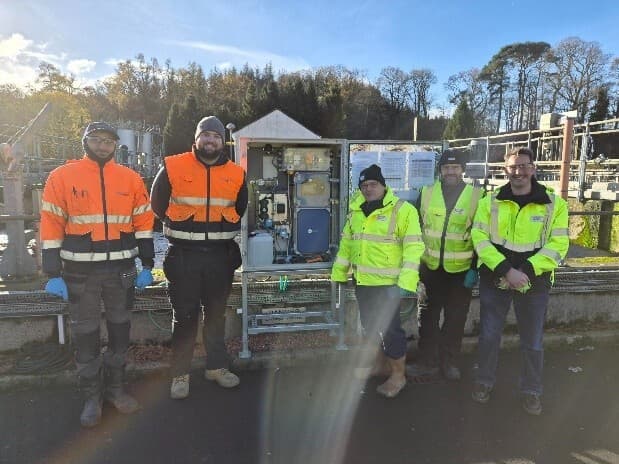
Aquamonitrix process emission liquid monitoring trials at Cumnock Wastewater Treatment Works

The Aquamonitrix control unit and site team
Trials have commenced using nitrite in the liquid phase as a proxy for nitrous oxide as a possible alternative to Unisense sensors. In conjunction with Aquamonitrix we are also developing a model which can utilise the nitrite data to give real-time nitrous oxide emissions.

CASE STUDY

HVO Use in Construction

Scottish Water has established a framework for the supply of sustainably sourced hydrotreated vegetable oil that can be used by both Scottish Water and its construction partners. It’s a drop in fuel replacement that reduces emissions by 90% compared to conventional diesel.

Over the last year it has been widely adopted by our construction partners, displacing diesel use in excavators, cranes and other heavy plant. It is also being used to fuel generators to provide power for remote construction sites.

On our water mains rehabilitation programme its adoption is expected to reduce emissions by nearly 30%.

CASE STUDY

Impact of broadleaf woodland creation

Forest Research are completing a review on woodland creation and water quality and quantity. This project is focusing on Broadleaf woodland creation to help inform current woodland creation and future strategy.

CASE STUDY

Douglas Park Community Consultation in Dundee

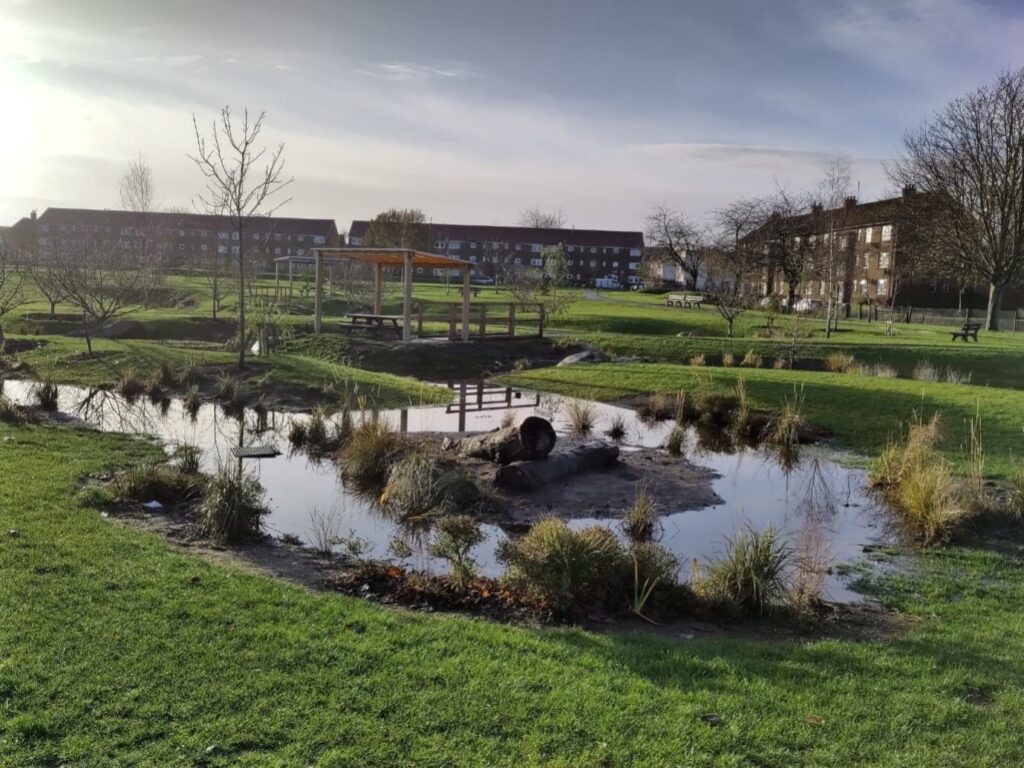
Scottish Water has been a partner in a project, led by the local community and supported by the National Lottery’s Community Fund, to regenerate the site once occupied by Douglas Primary School as a multi-functional greenspace.

Our team worked with the community to incorporate sustainable drainage features in the new park, which store and slowly release the rainwater that falls on surrounding roads and rooftops during storms. This eases pressure on the combined sewer network in the local area, as well as helping to protect the local environment and reduce flood risk from the Dighty Burn. Importantly, the community has been able to realise its wider aims by creating an attractive outdoor space that also provides a home for wildlife; and can be enjoyed for play, relaxation, exercise, events and the growing of food.

Planning is now underway to introduce more sustainable water management measures in the area surrounding the park, with the aim of disconnecting over 40,000m2 of land area from the combined sewer network; and helping to enable the development of more social housing in Douglas. Engagement with the community, including schools and other key stakeholders, is being carried out to help shape the proposals.

Work with the community and Dundee City Council on sustainable drainage for Douglas has helped to inspire the Water Resilient Dundee partnership. This initiative is now pursuing opportunities for more sustainable management of stormwater across the city, reducing flood risk in communities, creating capacity for development and enhancing amenity.